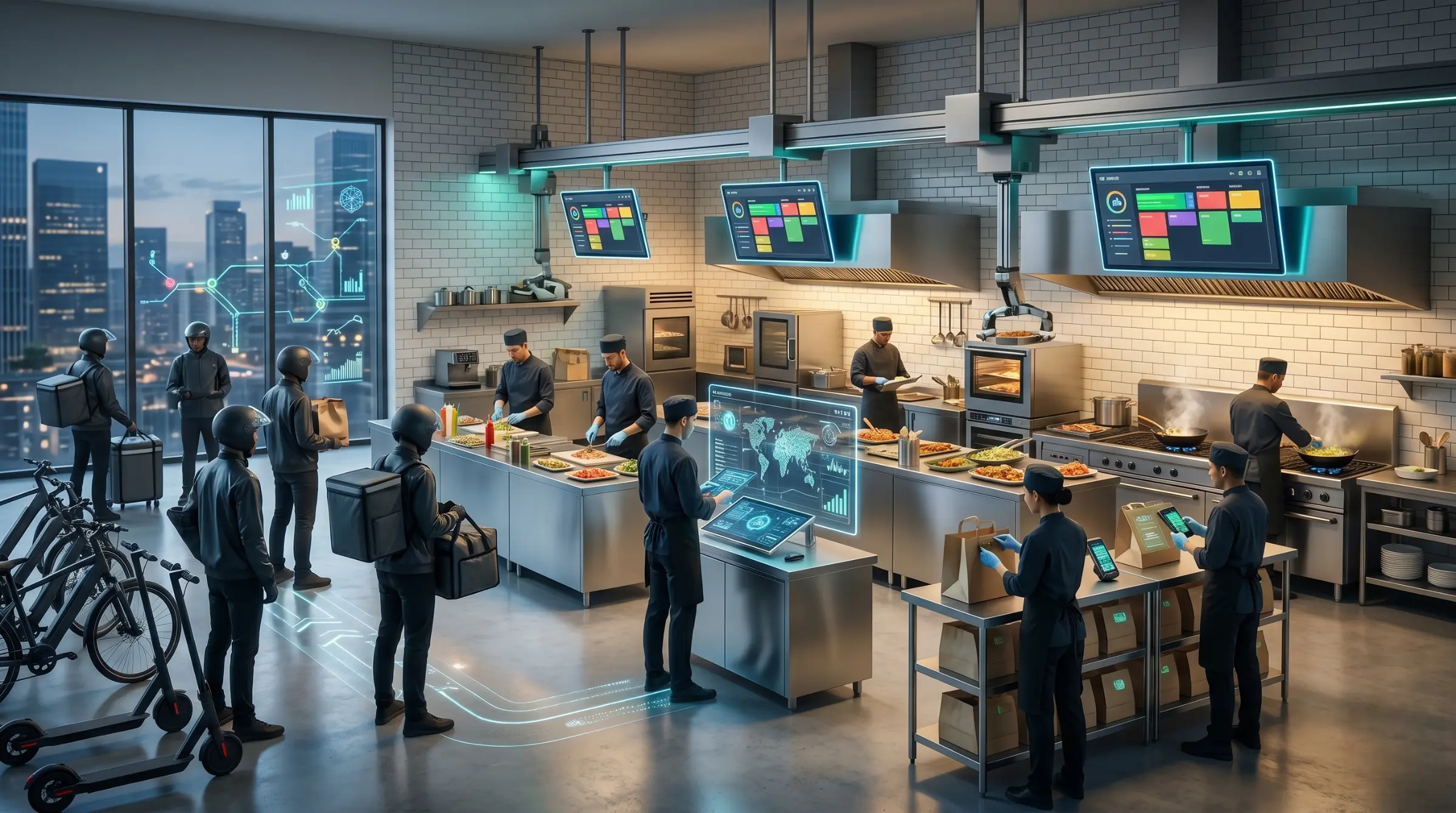
The cloud kitchen model has fundamentally changed what it means to run a food business. No front-of-house staff. No dine-in tables. No lease on a high-footfall location. Just a production kitchen, a delivery radius, and the right technology stack connecting every order, every ingredient, and every brand under one operational roof.
That last part is where most cloud kitchen businesses underinvest. The operational leverage that makes ghost kitchens profitable at scale does not come from the kitchen itself. It comes from the software managing it. This guide covers what cloud kitchen app development actually involves, which features drive operational efficiency, and what building or buying the right restaurant tech stack looks like in 2026.
What Is Cloud Kitchen App Development?
Cloud kitchen app development refers to building the software layer that manages the internal operations of a delivery-only food business. This is distinct from building a consumer-facing food ordering platform. Most cloud kitchens fulfill orders placed through third-party marketplaces like UberEats, DoorDash, or Zomato. The technology challenge is not attracting those orders. It is managing them efficiently once they arrive.
A production cloud kitchen running three virtual brands across four delivery platforms without integrated software is managing 12 separate order streams simultaneously. Staff are context-switching between tablets. Inventory is tracked on spreadsheets. Kitchen capacity is allocated by instinct rather than data. Custom cloud kitchen software eliminates that operational fragmentation and replaces it with a single unified system.
The Cloud Kitchen Technology Stack: Four Core Systems
Every cloud kitchen technology build centers on four interconnected systems that must work together in real time.
1. Order Aggregation Platform
This is the operational foundation. An order aggregation system pulls incoming orders from all connected delivery platforms (UberEats, DoorDash, Talabat, Swiggy, and others) into a single dashboard, eliminating the need for staff to monitor multiple tablets simultaneously. Orders route automatically to the correct virtual brand queue within the kitchen.
Key requirements include real-time sync with delivery platform APIs, automatic order status updates pushed back to each platform, and configurable routing rules when a single kitchen operates multiple brands simultaneously. Downtime or sync failures in this layer directly translate to delayed orders and customer complaints, so reliability architecture deserves specific investment.
2. Kitchen Display System (KDS)
The kitchen display system replaces printed tickets with real-time digital order screens positioned at each kitchen station. A well-built KDS shows station-relevant order components only: the grill station sees only the protein instructions while the assembly station sees the complete build. This reduces error rates and speeds up ticket times significantly.
Custom KDS builds also enable preparation time tracking, which feeds directly into the analytics layer. Knowing average ticket time by SKU, by time of day, and by kitchen staff allows operators to optimize both staffing schedules and delivery promise windows.
3. Inventory and Recipe Management
Inventory management in a cloud kitchen is more complex than in a traditional restaurant because one ingredient set services multiple virtual brands simultaneously. A chicken thigh, a portion of rice, and a sauce base might appear in dishes across three different branded menus. Custom inventory software tracks ingredient consumption at the recipe level rather than the dish level, triggering reorder alerts based on actual depletion rates rather than manual counts.
Recipe management integration ensures that every dish produced matches the specified cost and portion structure. Portion drift, where kitchen staff unconsciously over-portion high-cost ingredients, is one of the most common and least visible sources of margin erosion in cloud kitchen operations.
4. Virtual Brand Management Dashboard
Cloud kitchens running multiple virtual brands need a centralized interface to manage menus, pricing, and availability across all delivery platforms from a single location. Updating a menu item price or deactivating a sold-out dish on each platform individually through separate merchant portals is a time-consuming operation that creates pricing inconsistencies and availability errors.
A virtual brand management dashboard syncs changes to all connected platforms simultaneously. It also consolidates brand-level performance data, showing revenue, order volume, average basket size, and rating trends per brand in a single reporting view. This data layer is what makes the decision to launch, optimize, or retire a virtual brand commercially rigorous rather than intuitive.
Additional Features for Scaled Operations
Beyond the four core systems, cloud kitchens operating at scale require additional capabilities built into the platform:
Staff scheduling and labor management
Shift planning aligned to forecasted order volume by time slot and day of week. Labor cost as a percentage of revenue tracked in real time rather than reported retrospectively on weekly P&L statements.
Supplier and procurement management
Digital purchase orders, supplier communication, and goods received notes integrated with inventory so stock levels update automatically on delivery confirmation rather than through manual data entry.
Customer data capture
Third-party delivery platforms do not share customer data with restaurant operators. Cloud kitchens that want to build direct customer relationships need a mechanism to capture contact information and purchase history, typically through QR codes in packaging linking to a branded loyalty program or direct ordering microsite.
Delivery platform commission analytics
A consolidated view of gross order value versus net revenue after commission across each platform reveals which delivery marketplace is actually profitable for each virtual brand, enabling informed decisions about promotional spend and platform prioritization.
Tech Stack for Cloud Kitchen Software
1. Frontend:
React.js for the web-based operator dashboard and virtual brand management interface. For kitchen display systems deployed on wall-mounted tablets, a React Native or Flutter build enables cross-platform hardware compatibility. The cross-platform mobile app development with Flutter guide covers the architecture considerations relevant to restaurant-environment tablet deployments.
2. Backend:
Node.js for real-time order processing and delivery platform API integrations. WebSocket connections maintain live order status synchronization between the aggregation layer and kitchen display systems without polling delays.
3. Database:
PostgreSQL for transactional order and inventory data. Redis for real-time order queue state and KDS session management.
4. Infrastructure:
AWS or Google Cloud with high-availability configuration. Cloud kitchen software must not go offline during peak trading hours (Friday and Saturday evenings, lunch peaks). Multi-AZ deployment with automatic failover is a baseline infrastructure requirement, not a premium option.
5. Delivery platform integrations:
Most major delivery platforms (UberEats, DoorDash, Deliveroo, Talabat) expose merchant APIs for order management and menu synchronization. Integration requires platform-specific API credentials and ongoing maintenance as platforms update their API versions.
6. Payment and reconciliation:
Cloud kitchens receive weekly or biweekly consolidated payouts from delivery platforms rather than per-transaction payments. Automated reconciliation software that matches platform payout reports against aggregated order records is essential for financial accuracy. The data security principles from the FinTech app security checklist apply directly to financial data handling in multi-platform revenue reconciliation systems.
Build vs. Buy: Making the Right Decision
Off-the-shelf cloud kitchen management platforms (Otter, ItsaCheckmate, MarketMan) solve generic aggregation and inventory problems reasonably well for early-stage operations. The case for custom development strengthens as the operation scales:
Build custom when:
Operating more than five virtual brands simultaneously, running multiple kitchen locations, requiring deep integration with a proprietary POS or ERP system, or needing branded customer-facing features that off-the-shelf platforms do not support. In these scenarios, custom app development provides the flexibility, scalability, and control needed to support complex operational requirements and long-term growth.
Use off-the-shelf when:
Launching a first kitchen with one to three brands, testing market viability before committing to a proprietary platform, or operating in a delivery market where platform API coverage from existing tools is complete.
Many scaled cloud kitchen operators begin with off-the-shelf tools and commission custom development once their operational model is proven and their integration requirements have outgrown the generic platform’s capabilities.
Cloud Kitchen App Development Cost in 2026
| Platform Type | Estimated Cost | Timeline |
| MVP: Order aggregation and basic KDS | $30,000 to $65,000 | 2 to 4 months |
| Mid-tier: Full operator dashboard with inventory and brand management | $70,000 to $150,000 | 4 to 7 months |
| Enterprise: Multi-location platform with analytics and custom integrations | $160,000 to $350,000+ | 8 to 14 months |
The technology investment calculus is straightforward: a cloud kitchen operating at 200 orders per day, losing 8 minutes per order to manual tablet management and data entry, is losing over 26 hours of staff productivity daily. Custom software that recovers even half of that time pays for itself quickly at scale.
The architecture decisions in cloud kitchen software also share meaningful overlap with the broader logistics app development category, particularly around real-time dispatch, route optimization, and last-mile coordination for kitchens operating their own delivery fleet rather than relying exclusively on third-party drivers.
Choosing a Development Partner
Cloud kitchen software requires a development partner who understands both food service operations and API integration complexity. Most agencies have no direct experience with delivery platform merchant APIs, KDS hardware constraints, or the real-time reliability requirements of a production kitchen environment.
Evaluate candidates on documented hospitality tech or food-tech project experience specifically. Review whether their past work includes multi-platform integrations rather than single-source data builds. For teams beginning their vendor search, the top mobile app development companies in the USA directory provides a useful starting reference for identifying agencies with relevant vertical experience.
The distinction between cloud kitchen software and a consumer-facing food delivery platform matters when briefing agencies. They are different products solving different problems for different users, and a vendor who conflates them in their proposal has not understood the brief.
Conclusion
The cloud kitchen model’s profitability is fundamentally a technology problem. Kitchens that operate multiple brands across multiple delivery platforms with fragmented, manual systems are leaving margin on the table at every order. The operators winning in this market have invested in software that turns operational data into real-time decisions: which brands to promote, which platforms to prioritize, which ingredients to reorder, and which kitchen stations are creating bottlenecks.
The demand for specialized restaurant technology platforms continues to grow as operators seek greater efficiency and control over delivery operations. Building a scalable solution requires expertise in delivery integrations, kitchen workflows, and real-time system reliability. Businesses that invest in the right foundation early can scale more efficiently and adapt to changing market demands. At AppFirmsReview, we help businesses identify trusted development partners capable of building reliable, future-ready platforms that support long-term growth.
FAQs
1. What is cloud kitchen app development?
Cloud kitchen app development involves building software that manages delivery-only restaurant operations, including order aggregation, kitchen workflows, inventory tracking, virtual brand management, and business analytics. It focuses on operational efficiency rather than consumer food ordering.
2. How much does it cost to build cloud kitchen software in 2026?
Costs typically range from $30,000–$65,000 for an MVP, $70,000–$150,000 for a full-featured platform, and $160,000–$350,000+ for enterprise-grade solutions with custom integrations and advanced analytics.
3. What are the must-have features of a cloud kitchen app?
Essential features include order aggregation, kitchen display systems (KDS), inventory management, virtual brand management, delivery analytics, and consolidated revenue reporting.
4. Should a cloud kitchen build custom software or use an off-the-shelf platform?
Off-the-shelf solutions suit smaller operations with limited brands and locations. Custom development is often the better choice for multi-brand businesses, multiple kitchens, proprietary integrations, or unique operational requirements.
5. What tech stack is recommended for cloud kitchen app development?
A common stack includes React.js for dashboards, React Native or Flutter for KDS applications, Node.js for backend services, PostgreSQL and Redis for data management, and AWS or Google Cloud for scalable infrastructure.