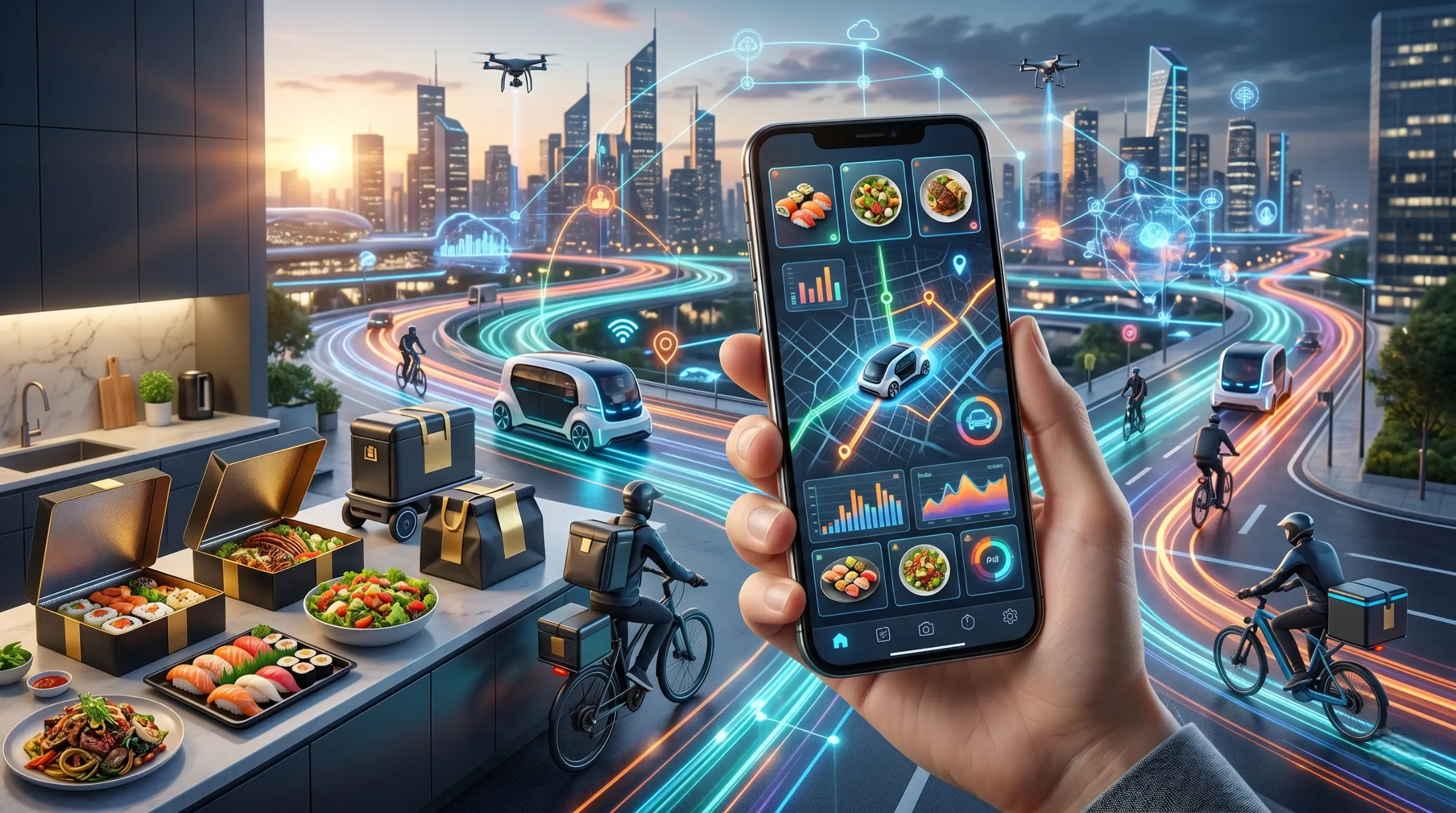
The global online food delivery market is projected to surpass $1.65 trillion by 2030, and the engine running beneath that number is software. Every time a customer taps “order,” a cascade of coordinated actions fires across multiple systems: menu inventory syncs, a payment processes, a kitchen receives a ticket, a driver gets dispatched, and a real-time tracking link lands in someone’s pocket. None of that happens by accident. It happens because someone made the decision to build a food delivery app the right way.
Whether you are a restaurant chain evaluating a branded ordering app, a founder building the next regional aggregator, or a cloud kitchen operator looking to cut third-party commission fees, this guide covers everything you need before writing your first line of code.
The Business Case for Building Your Own Food Delivery App
The dominant platforms (UberEats, DoorDash, Zomato, Deliveroo) extract 15 to 35% commission on every order processed through their marketplaces. For restaurants operating on already-thin margins, that commission frequently eliminates profitability on delivery orders entirely.
Building a proprietary food delivery app addresses this directly. Businesses that own their ordering infrastructure retain the full order value, own the customer relationship, and capture first-party data that fuels loyalty programs and targeted marketing in ways third-party platforms never allow. Beyond the commission argument, custom mobile apps deliver brand control, direct customer communication through push notifications, and operational flexibility around delivery zones, surge pricing, and promotional mechanics.
Business Models: Choosing the Right Architecture
Your business model determines your feature set and development complexity before a single design decision is made.
1. Restaurant-owned ordering app:
A single restaurant or chain builds a branded app for direct ordering. Lowest complexity, fastest to market. Domino’s and McDonald’s are the canonical examples at scale.
2. Aggregator marketplace:
A platform listing multiple restaurants, handling customer ordering, and managing delivery logistics. The most technically complex model, requiring multi-vendor management, commission tracking, logistics app development capabilities, and three-sided coordination across customers, restaurants, and drivers.
3. Logistics-only platform:
The platform handles delivery operations for restaurants that manage their own ordering. Requires sophisticated fleet management and real-time dispatch mechanics.
4. Cloud kitchen app:
A delivery-only food brand with no physical dining room. The app is the primary sales channel, and kitchen-to-doorstep operational efficiency is the entire competitive advantage.
Must-Have Features of a Food Delivery App
A production food delivery platform runs on three parallel apps that must work in perfect coordination: the customer app, the restaurant merchant panel, and the delivery driver app.
Customer App
1. Smart menu browsing and search.
Customers should reach any item within three taps. Filters by cuisine, dietary preference, price range, and estimated delivery time are baseline requirements.
2. Real-time order tracking.
Live GPS tracking from kitchen confirmation to doorstep delivery, with status updates that push automatically rather than requiring a manual refresh.
3. Multiple payment options.
Cards, digital wallets (Apple Pay, Google Pay), cash on delivery, and saved payment methods with one-tap reorder reduce checkout abandonment significantly.
4. Ratings, reviews, and reorder.
Post-delivery rating prompts drive the review volume that determines restaurant rankings. One-tap reorder of previous orders consistently outperforms discount-based retention.
5. Loyalty and promotions.
Points per order, milestone rewards, and referral bonuses drive the repeat frequency that determines lifetime value.
Restaurant / Merchant Panel
1. Order management dashboard.
A tablet-optimized interface showing incoming orders, preparation time controls, and real-time status updates with auto-cancellation timers.
2. Self-serve menu management.
Item availability, pricing, and photo updates without requiring developer intervention. Real-time menu sync is critical: a sold-out item showing as available is a satisfaction problem.
3. Revenue and analytics reporting.
Daily order volume, revenue by item, average order value, and peak hour data give operators what they need to optimize both menu and operations.
Delivery Driver App
1. Job queue and acceptance flow.
Available pickup jobs within proximity radius with upfront payout displayed. One-tap acceptance with a countdown timer prevents job abandonment.
2. Embedded navigation.
Turn-by-turn directions with delivery sequence optimized for multiple drop-offs per trip.
3. Proof of delivery.
Photo capture or customer PIN confirmation for dispute resolution.
4. Earnings dashboard.
Real-time visibility into shift earnings, completed deliveries, and incentive bonuses. Transparency in earnings is the primary driver of driver retention.
5. Offline functionality.
Order details, navigation data, and POD capture must function through poor-connectivity areas and sync when connection returns.
Tech Stack Recommendations
Mobile (Customer and Driver Apps):
Flutter or React Native for cross-platform deployment. Shipping one codebase to iOS and Android simultaneously reduces both build time and ongoing maintenance cost. The cross-platform mobile app development with Flutter guide covers the architectural tradeoffs in detail.
Web (Restaurant Panel and Admin Dashboard):
React.js for the merchant-facing panel and internal admin tools.
Backend:
Node.js for real-time order processing microservices. WebSocket connections handle live order status updates across all three apps simultaneously. Python handles the analytics pipeline and recommendation engine.
Database:
PostgreSQL for transactional order and user data. Redis for session management and real-time caching. Elasticsearch for fast menu search across large restaurant catalogs.
Infrastructure:
AWS or Google Cloud with auto-scaling to handle demand spikes. Friday evenings and sporting events create 300 to 500% traffic surges that fixed-capacity infrastructure cannot absorb.
Key integrations:
Google Maps Platform for tracking and navigation, Stripe or Razorpay for payment processing, Twilio for SMS and OTP, and Mixpanel or Amplitude for behavioral analytics.
Payment Security and Compliance
PCI DSS compliance is mandatory for any app processing cardholder data. The practical implementation involves tokenizing card data through a certified payment processor so your servers never handle raw card numbers directly. GDPR governs customer data in EU markets, and CCPA applies in California. The FinTech app security checklist provides a transferable API security framework that food delivery development teams apply directly when structuring payment and authentication architecture.
Development Cost in 2026
| Platform Type | Estimated Cost | Timeline |
| MVP: Single-restaurant ordering app | $25,000 to $55,000 | 2 to 3 months |
| Mid-tier: Regional multi-restaurant aggregator | $80,000 to $160,000 | 4 to 7 months |
| Full marketplace with ML features | $180,000 to $400,000+ | 8 to 14 months |
Post-launch operational costs for server infrastructure, third-party API fees, and security updates typically run $3,000 to $8,000 per month for a mid-scale regional platform.
Monetization Models
Commission per order (15 to 30% from restaurants) is the dominant aggregator model. Delivery fees charged to customers are a direct revenue line, with dynamic pricing based on distance and demand. Subscription plans offering unlimited free delivery above an order minimum improve retention and smooth revenue predictability. Restaurant advertising fees for sponsored placements apply to aggregator models with sufficient restaurant supply.
Post-Launch Growth
Consumer food apps compete in one of the most crowded categories on both the App Store and Google Play. Applying structured app store optimization tactics from week one, specifically keyword-optimized metadata and review velocity strategies, accelerates organic discovery significantly.
For aggregator models, restaurant onboarding velocity determines customer satisfaction more than any feature. Build self-serve restaurant registration and POS menu import tools into the product roadmap before launch. Driver supply management during peak hours is the leading cause of customer churn; configurable incentive mechanics and shift guarantees need to be in the platform, not managed through spreadsheets.
For teams beginning vendor evaluation, the top mobile app development companies in the USA directory is a useful starting reference. Prioritize agencies with documented on-demand marketplace experience. The architectural demands of a food delivery platform share more with the logistics app development category than with a standard e-commerce or content app.
Conclusion
Building a food delivery app in 2026 is not about cloning an existing platform. The businesses that win are building with deliberate business model alignment, operational three-sided coordination, and a data infrastructure that compounds over time into a real competitive advantage. The commission economics alone make the owned-platform argument compelling for any restaurant group processing meaningful delivery volume. The window to capture loyal regional audiences before markets consolidate further is open now and will not stay open indefinitely.
At AppFirmsReview, we help businesses discover trusted food delivery app development companies, compare technology partners, and make informed decisions for building scalable, future-ready delivery platforms. Our expert insights, curated company rankings, and industry-focused resources simplify the process of choosing the right development partner for long-term business growth.
FAQs
1. What is food delivery app development?
Food delivery app development is the process of building a mobile and web platform that connects customers, restaurants, and delivery drivers for seamless online food ordering. It typically involves three coordinated applications: a customer ordering app, a restaurant merchant panel, and a driver delivery app, all integrated through a shared real-time backend.
2. How much does it cost to develop a food delivery app in 2026?
Food delivery app development costs range from $25,000 to $55,000 for a single-restaurant branded ordering app MVP, $80,000 to $160,000 for a regional multi-restaurant aggregator, and $180,000 to $400,000+ for a full three-sided marketplace platform with ML-driven features like personalized recommendations and dynamic pricing.
3. How long does it take to build a food delivery app?
A single-restaurant ordering MVP takes 2 to 3 months. A regional aggregator platform takes 4 to 7 months. A full marketplace with three-sided coordination and advanced features typically requires 8 to 14 months of development.
4. What are the must-have features of a food delivery app?
Core features include real-time GPS order tracking, smart menu browsing with filters, multiple payment options with PCI DSS compliance, one-tap reorder, a restaurant merchant dashboard with self-serve menu management, a driver app with job queue and proof-of-delivery capture, and post-delivery ratings.
5. What tech stack is recommended for food delivery app development?
Best-practice stacks use Flutter or React Native for cross-platform mobile apps, React.js for web dashboards, Node.js for real-time order processing, PostgreSQL and Redis for data storage, and AWS or Google Cloud with auto-scaling infrastructure. Google Maps Platform handles delivery tracking and navigation while Stripe or Razorpay manages payment processing.