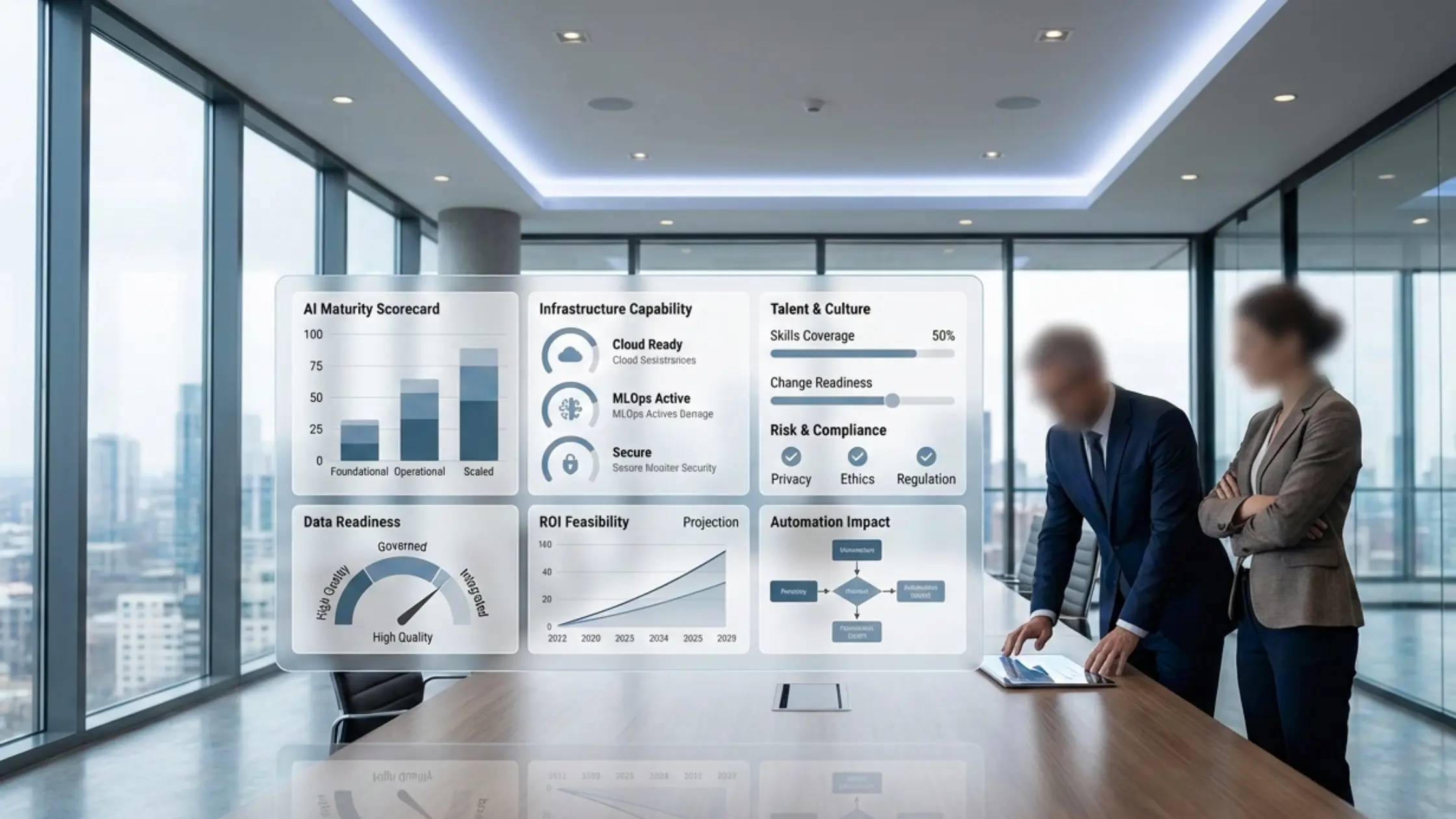
Artificial intelligence (AI) has become a practical tool that all businesses, irrespective of their industry or size, want to adopt enterprise AI adoption trends and relevant AI solutions successfully. Yet, according to a survey, 74% of companies have yet to see measurable business value in scaling AI. This is where an AI readiness assessment comes in and helps you evaluate and check whether your business is ready to embrace modern enterprise AI adoption trends.
But how does evaluating the AI readiness score ensure that your AI initiatives succeed and that you save time or reduce overall AI app development cost? This blog will help you understand the concept behind AI readiness assessment and key metrics to evaluate your business’s AI maturity or preparedness level.
Understanding the Term “AI Readiness Assessment”
The AI readiness assessment is a systematic process that evaluates how the internal ecosystem of the company works across various departments, such as strategy, data, technology, etc. This evaluation is important as it helps you to determine whether your organization is ready for implementing enterprise AI adoption trends effectively.
Now you must be wondering what an AI readiness score is. It basically refers to a quantifiable metric or a mature level checking metric that reflects your organization’s overall preparedness level for integrating AI and its solutions within your existing ecosystem.
If you are considering investing in AI-powered app development, partnering with an AI app development company can help you build next-generation intelligent solutions by understanding your AI readiness.
Why Businesses Struggle in Leveraging AI and Its Complete Adoption
AI and its solutions offer various benefits such as reduced operational costs, improved decision-making, better business growth, and accelerated innovation of the organization. Yet, despite these key advantages, many organizations struggle to leverage full-scale AI adoption effectively. Here are the top 3 common reasons why businesses struggle in implementing enterprise AI adoption trends:
1. Data Silos & Quality
AI models rely heavily on clean and structured data sets that are actually accessible. However, 57% of organizations still deal with data silos and estimate that their data is not AI-ready. They struggle with poor data quality and fragmented data silos.
2. Internal AI Knowledge
Many enterprises face a critical skill gap and shortages, such as technical AI-related skills, data engineering expertise, and cross-departmental collaboration as well. For a successful AI adoption, you require an experienced team that has specializations in the following fields:
- Machine Learning
- Data Analysis & Engineering
- AI Strategy
- Product Management
- DevOps & Software Development
Without the right team and training, your AI-powered apps will lack expertise and skills, thus leading to failure.
3. Weak Governance and Compliance
Many organizations also face issues in complying with the legal regulatory bodies and establishing governance and policies for transparency and complete fairness. Having weak governance or neglecting to implement policies can result in the company’s reputation damage, hefty legal fines, and also project shutdown.
Key Metrics to Measure Enterprise AI Readiness
If your goal is to gain knowledge about your organization’s ability to implement AI and sustain and scale it to use it effectively, you must consider these key metrics. The AI readiness assessment process involves identifying, analyzing, and measuring key metrics that may influence your AI integration’s success and longevity. Here are the top metrics you should evaluate for your AI readiness assessment:
1. Data Quality and Maturity Level
Data quality and its maturity level are one of the crucial metrics to know while evaluating your AI readiness assessment. The one thing that matters the most is the quality of data.
It’s a fundamental metric in AI readiness assessments, and if you lack here, and have fragmented data silos or unstructured data, then it reflects on your AI readiness level. On the other hand, if your data is clean and well-defined, then your AI readiness score will be high.
3. Organizational Culture
The company’s culture is another important metric in your AI readiness assessment, making or breaking your enterprise AI adoption. Before implementing any AI solution or application, you need to check how willing your organization is to make changes in processes, workflows, or even the existing business model. This aspect showcases and highlights your company’s adaptability.
If your business culture supports and embraces innovations and various experiments, your AI readiness assessment score will be higher, and you will have a 100% successful AI adoption.
3. Talent Availability
Talent availability and the right team play a vital role in determining whether your organization is ready to adopt and scale AI and its solutions. For a higher AI readiness score, you need to have skilled AI professionals like ML engineers, data scientists, and AI-domain experts, who help you build and monitor AI systems efficiently.
Without these capabilities, you will have to rely on external vendors, especially a Mobile App Development Company. This will lead to a major decline in your AI readiness score. In contrast, having a strong internal talent pool will significantly boost your AI readiness assessment’s maturity levels.
4. Scalable Infrastructure
A robust and scalable infrastructure is another critical metric that may influence your AI implementation success and AI readiness assessment levels. To build a robust infrastructure, you need to implement emerging AI trends, including computing capabilities, serverless cloud environments, edge devices, and secure CI/CD pipelines.
If your infrastructure is outdated or can’t handle heavy AI workloads, adopting and scaling AI becomes a challenge. However, if you have a flexible, cloud-driven, and scalable architecture, you will achieve a higher AI readiness assessment score.
5. Financial Readiness
Financial readiness, or the AI app development cost initiative, is another key metric that may influence your AI readiness assessment’s total score. Adopting AI initiatives requires a consistent and continuous investment that doesn’t stop at developing and implementing an AI solution.
If your business has a long-term financial plan and enough budget for infrastructure upgrades, talent, and extensive training, then your AI readiness level increases. But if you have a budget problem, then your AI readiness score will be lower and may slow down your AI transformation journey.
Closing Statement
Conducting internal enterprise AI readiness assessments is crucial for successful AI adoption and scaling it effectively. To assess your organization’s AI readiness score, you need to evaluate metrics across data maturity, culture, talent, and financial stability domains, as discussed above.
Assessing these metrics and gaining knowledge of whether your organization is ready to take risks and build a scalable AI solution will enable you to create a clear roadmap and ensure that your AI initiatives deliver continuous and long-term business value. At AppFirmsReview, we can help you find the right AI development strategy that aligns perfectly with your specific goals and helps you achieve greater ROIs.
FAQs:
1. What is an AI readiness score?
AI readiness score refers to an evaluation maturity level that reflects how prepared your organization is to implement AI solutions and scale them later. To measure the AI readiness score, you need to check factors such as data quality, infrastructure, the organization’s culture, and financial readiness.
2. Why does AI readiness matter before building AI apps?
AI readiness level matters before developing and seamlessly implementing AI apps or solutions, as this will help you evaluate your organizational mindset and the technical capabilities of your existing team.
3. What factors influence enterprise AI readiness?
Key metrics or factors that influence the overall enterprise AI readiness score are as follows:
- Data Quality
- Technical Skills
- Right Talent
- Organizational Culture
- Financial Capabilities
4. How can SMBs measure AI readiness without internal AI teams?
Small businesses or startups can partner with top AI development companies, external tools, and consult with AI experts who evaluate their data or processes. These AI readiness assessments help identify gaps and provide the right roadmap for AI adoption.