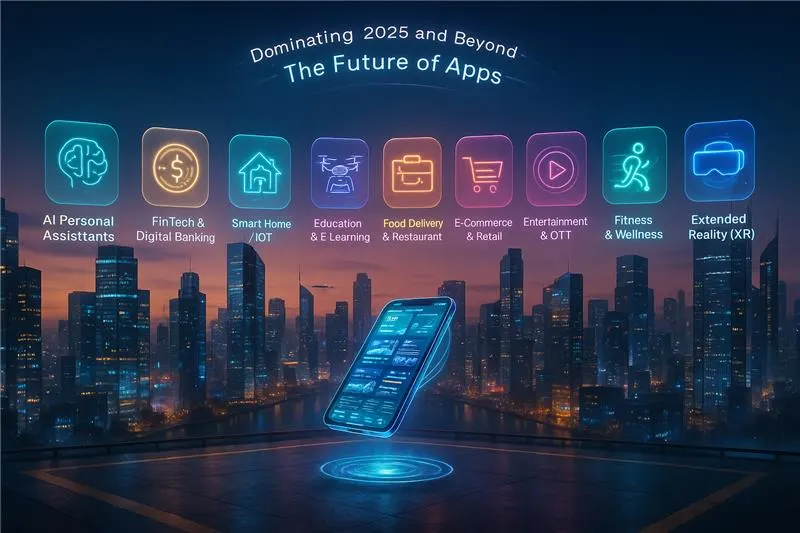
The mobile app market has experienced significant growth since the introduction of smartphones. With the continuous technological advancements, opportunities for advanced apps that solve real-world problems and enhance user experiences are arising. Businesses are finding ways to transform these opportunities into a high-performing mobile app.
According to Grand View Research, the global mobile app market size was estimated at $252.89 billion in 2023 and is projected to reach $626.39 billion by 2030. Therefore, businesses must adopt mobile-first strategies to remain well-positioned in this rapidly expanding market.
Many technologies like AI, AR/VR, IoT, and blockchain are reshaping app development, driving growth, and redefining user experience and opening doors for new app categories. These growing app categories will dominate 2025 and beyond due to continuous growth. In this blog, we’ll explore these categories to help you select the right one and establish a strong foothold in the industry. So, let’s get started:
1. AI Personal Assistant Apps
Artificial Intelligence has progressed from novelty chatbots to extraordinary productivity tools. In 2026, AI-powered personal assistant apps will become even more advanced because they use natural language processing (NLP), predictive analysis, and deep personalization. There is a huge scope for AI-powered apps in 2026. These apps are not limited to scheduling meetings and setting reminders. These apps can:
- Proactively anticipate your needs
- Analyze your habits to optimize daily routines
- Summarize emails and documents
- Help with research and decision-making
For example, you have an AI assistant app that reviews your calendar, suggests when to recharge, recommends podcasts you might love, and even books reservations. This app category is a big opportunity for startups creating AI assistants for lawyers, doctors, freelancers, and students.
2. Medical Apps
The demand for medical applications is increasing rapidly due to their different use cases. Doctors and physicians can use these applications for scheduling appointments, check-ins, appointment reminders, and more. Some of these applications can do post-appointment surveys.
After the pandemic, the demand and adoption of telemedicine apps have accelerated, but the trend is far from over. In the future, telehealth apps will expand their capabilities and they will help in doing work like:
- Remote diagnostics using connected devices
- Virtual therapy and counseling
- AI symptom checkers
- Medication management and reminders
According to a recent study, 90% of US adults use at least one digital health tool. And 93% of doctors believe that mobile health apps can improve patient health. Statistics like this speak for themselves, and they tell us that businesses should invest in this app category to establish a strong foothold.
3. Fintech Apps
The financial industry is growing, and businesses are using mobile apps to simplify financial services and transactions. That’s why the demand for FinTech apps. The different types of apps are mobile banking apps, mobile payment apps, asset management apps, and personal finance apps. These applications are seeing a rise in user adoption and usage.
According to Google reports, 73% of smartphone users focused on using a mobile app to manage their finances within the last month. After the pandemic, the fintech apps saw a 90% increase in the number of installs worldwide. You can check out the guide to banking app development to understand the necessary information. These apps are growing because the world is turning digital, and users can manage their finances in a single mobile app, saving time and money. However, businesses need to build user trust and comply with regulations to succeed in this category.
4. Smart Home and IoT Apps
With smart home devices growing and becoming more affordable, IoT real-world applications are allowing users to connect and control them. From thermostats and lights to security cameras and kitchen appliances, consumers increasingly expect seamless control through a single interface. In the future, smart home apps can:
- Offer more granular automation routines
- Integrate with AI assistants like Alexa and Google Assistant
- Use machine learning to optimize energy consumption
- Enhance security with biometrics and MFA
These applications can enhance home security, sustainable living, and elder care. That’s why businesses can focus on building apps in these categories to make themselves future-ready. However, it’s important to focus on interoperability and data privacy.
5. Education and E-Learning Apps
The knowledge economy is growing rapidly because lifelong learning has become non-negotiable. After the pandemic, remote learning has become a new normal in our lives. Edtech apps hold the third app store category ranking. It has increased the demand for education and e-learning applications. These apps are among the most popular app store categories.
Many businesses have launched these apps, and they have achieved tremendous success. E-learning and education apps cater to students, professionals, and hobbyists alike. The key trends shaping the future of edtech apps are:
- Microlearning modules
- Interactive simulations and AR experiences
- Gamification for engagement and retention
- AI tutors providing personalized feedback
From learning a new language to mastering soft skills, anything can be done through edtech apps with a few taps. Applications that help kids learn new concepts are making waves in the industry, and startups can launch them to generate a substantial amount of revenue.
6. Restaurant and Food Delivery Apps
The food and drink industry has faced challenges, but the industry is heading towards a significant transformation. Ever since the lockdown, many restaurants have built mobile apps to survive and thrive in this competitive industry.
According to Business of Apps, the entire food delivery app industry is expected to reach $213 billion by 2030. China and the United States are ahead in the total revenue for food delivery, with $40.2 billion and $29.7 billion, respectively. They saw the growth after the pandemic.
This growth highlights the importance of launching food delivery and restaurant applications because users prefer ordering food from these apps. Also, they give restaurants full control over their margins because they don’t have to pay the fees associated with third-party services.
7. E-Commerce Apps
E-commerce applications are making shopping convenient and hassle-free. People prefer these applications instead of visiting stores and consuming more time and money. Some reports projected that 23% of global retail revenue is projected to be generated from selling products online. An e-commerce app can stand out from the others by providing unique features like AR and virtual try-ons or a more personalized shopping experience.
Mobile applications can be a perfect way of establishing a strong e-commerce presence, even if you are a small retailer interested in increasing your online presence. This app category can be a game-changer for startups if they are focusing on building different apps.
8. Entertainment Apps
Gone are the days of watching cable TV; now people prefer watching movies and shows on entertainment applications. These apps allow easy access to watch movies and series with some unique features to help you track your activity.
This is one of the top Android app categories. However, there are several giants such as Netflix, Prime Video, Apple Video, etc, but offering best-in-class features and engaging content can make your app more popular among the audience.
The global online entertainment market, including apps, was valued at $99.98 billion in 2024 and is projected to reach $261.23 billion by 2032. These numbers are enough to understand the growth in this industry. Building an entertainment app can be an ideal choice for your business.
9. Health and Fitness Apps
This industry is growing like never before because people are motivated to be fit and are growing more aware of their health. This explains why there are so many fantastic apps in this industry.
These applications are popular among people because they allow individuals to focus on staying on top of their fitness objectives. Whether you are a startup or an enterprise, building a health and fitness app can help you reach a larger audience and maximize ROI.
These applications provide simple workout plans tailored to each user’s requirements. Additionally, you can offer features for meditation and mental relaxation. However, these are different kinds of apps, but they can help you reach more users and achieve success.
10. Extended Reality (XR) Apps
One of the recently popular and emerging mobile application categories is Extended Reality (XR). It is an umbrella that covers augmented reality (AR), virtual reality (VR), and mixed reality (MR). Tech giants like Apple and Meta are pushing immersive experiences, and XR apps have the potential to move from experimental to mainstream. In the future, these apps will be used for:
- Virtual shopping showrooms
- 3D social hangouts
- Remote collaboration and training
- Immersive gaming
- Virtual tourism and real estate tours
In 2025, XR apps can be more accessible as hardware becomes cheaper and 5G enables a richer experience with less buffering. However, startups need to focus on intuitive design and cross-device compatibility to lower barriers to adoption.
Conclusion
These app categories were chosen after seeing their growth and the opportunities for businesses. From AI making life easier to XR making it richer, the opportunities are enormous, and businesses have a high chance of achieving success because these app categories are future-ready. However, building your desired app in one of these categories can be challenging, and businesses need to partner with an experienced mobile app development company. This partnership can help them deliver real value to the users and dominate the market for decades. Learnt about the top app categories? Discover more valuable business-focused blogs at AppFirmsReview.
FAQs
Q1. What types of mobile apps will be most popular in 2025?
In 2025, popular mobile app types will likely include super apps offering multiple services, AI-powered apps with advanced personalization, and those leveraging extended reality (XR).
Q2. Which app category is the most profitable in 2025?
Fintech and e-commerce apps are likely to be the most profitable app categories, driven by the increasing reliance on digital transactions and online shopping. Apart from them, gaming and social media apps also have the potential to generate significant revenue.
Q3. Are educational apps still in demand in 2025?
Yes, educational apps are still in demand in 2025 because e-learning is projected to continue its strong growth trajectory. The demand is influenced by the increasing popularity of digital learning.
Q4. What are the 10 most popular apps?
The most popular apps worldwide in July 2025, based on monthly downloads, are ChatGPT, TikTok, Instagram, Facebook, WhatsApp, Temu, CapCut, Threads, Telegram, and Snapchat.
Q5. What is the most popular app category?
The most popular app category around the world in 2025 is gaming, based on downloads. This app category represents over 40% of all app downloads worldwide. However, it’s important to understand that the popularity of apps can vary depending on the app stores.